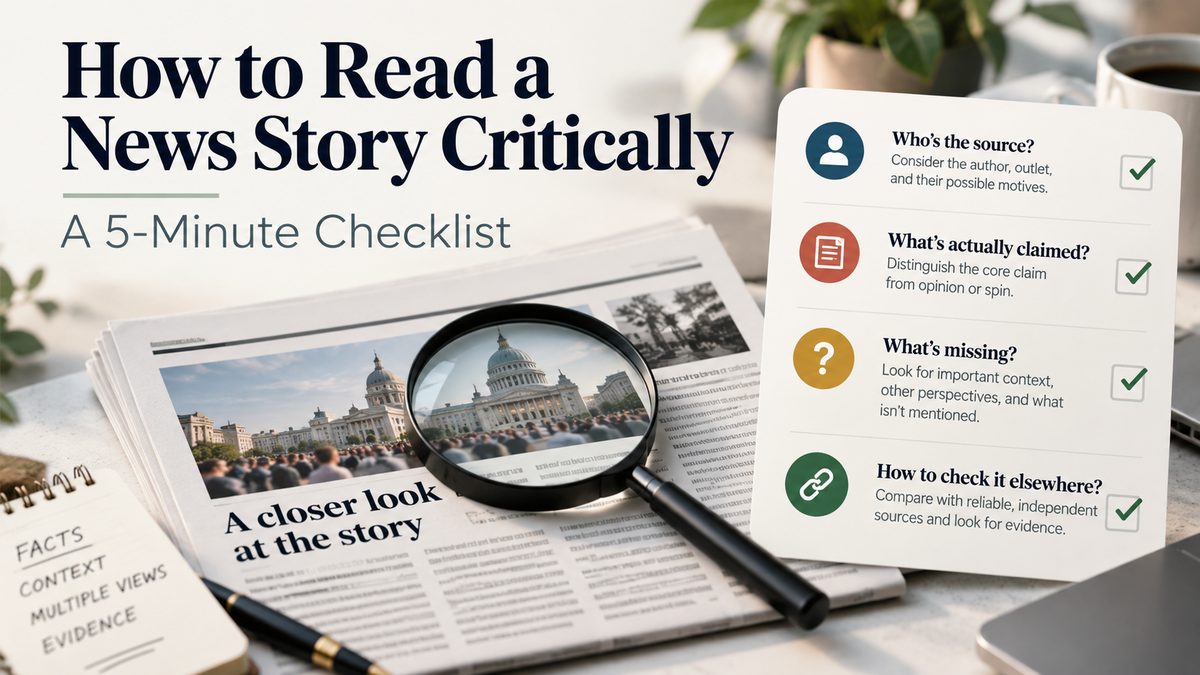
How to Read a News Story Critically: A 5-Minute Checklist
News moves fast. Good judgment does not have to.
You do not need to spend an hour researching every article you read. In many cases, five minutes is enough to determine whether a story deserves your confidence, your skepticism, or a closer look.
Here is a simple checklist you can use before accepting or sharing a news story.
1. Who is the source?
Start with the publication and the author.
Ask:
- Is the article from an established news organization, a specialized publication, a government agency, a company, or an individual website?
- Is the author identified?
- Does the author have experience covering the subject?
- Does the site clearly explain who owns or operates it?
A recognizable name does not automatically make a story accurate, and an unfamiliar publication is not automatically unreliable. The important question is whether the source is transparent about who produced the information and where it came from.
Also distinguish between news reporting, analysis, opinion, sponsored content, and press releases. They serve different purposes and should not be evaluated in exactly the same way.
2. What is actually being claimed?
Headlines are designed to get attention. The article itself may make a much narrower claim.
Before reacting, put the main claim into your own words.
For example, there is a major difference between:
“Study proves Product X prevents disease.”
and:
“A small preliminary study found an association that researchers say deserves further investigation.”
Look for the specific evidence supporting the headline. Is the article reporting a confirmed event, quoting someone’s allegation, describing a prediction, interpreting data, or repeating information from another source?
Words such as may, could, reportedly, allegedly, suggests, estimates, and according to matter.
They tell you how certain the information really is.
3. What evidence supports the story?
Strong reporting usually shows you where the information came from.
Look for:
- Named sources
- Public records
- Court documents
- Government data
- Research studies
- Direct interviews
- Official statements
- Photographs or video with clear context
Be more cautious when an article depends heavily on unnamed sources, screenshots without context, social-media posts, secondhand accounts, or vague phrases such as “experts say” without identifying the experts.
Anonymous sources can sometimes be necessary, particularly when people face professional or personal consequences for speaking publicly. But the article should give you some reason to understand why those sources are credible.
4. What is missing?
This is one of the most useful questions you can ask.
A story can contain accurate facts and still create a misleading impression by leaving out important context.
Consider:
- Is another relevant perspective included?
- Are important numbers presented without comparison?
- Is a percentage being reported without the underlying totals?
- Is an old quotation being presented as though it were new?
- Does the story explain what happened before the event being described?
- Are there limitations to the study, poll, statistic, or evidence?
- Is correlation being treated as proof of causation?
Also pay attention to what the article cannot establish.
A responsible news story will often acknowledge uncertainty rather than pretending every question has already been answered.
5. Can you confirm it somewhere else?
Before accepting an important claim, check whether other credible sources are reporting the same basic facts.
Do not simply look for another website repeating the identical story. Several sites may all be copying one original report.
Instead, look for independent confirmation.
For a government decision, check the relevant agency.
For a court ruling, look for the decision or reliable legal reporting.
For a scientific claim, look for the original study or coverage from reputable scientific or medical organizations.
For company news, compare the company’s announcement with independent reporting.
For breaking news, remember that early reports frequently change as more information becomes available.
The 5-Minute Test
Before you believe or share a story, ask four questions:
Who is telling me this?
What are they actually claiming?
What important information might be missing?
Can I confirm the central claim independently?
You do not have to distrust everything you read.
You simply have to separate what is known, what is claimed, what is interpreted, and what has not yet been established.
That habit takes only a few minutes, and it can dramatically improve the quality of the information you rely on.